An internal tool to transform partner onboarding process into a streamlined, trackable pipeline; built from scratch with no-code and adopted company-wide.
Internal Tool
Product thinking
Role
Product Designer
Timeline
12 weeks
team
Me (+ Lovable)
platform
Web

The problem
As the person responsible for onboarding new partners at TransferZ, I was constantly fielding the same question: "What stage is X partner at?" The answer lived in my head, in scattered spreadsheets, and in Confluence pages that not everyone had access to. There was no single place where the team could see the full picture — who was being onboarded, where they were stuck, and what still needed to happen.
The problem wasn't just visibility. It was that every part of the process — tracking stages, sending emails, managing documents, updating guides — lived in a different tool with no connection between them.
What I Built
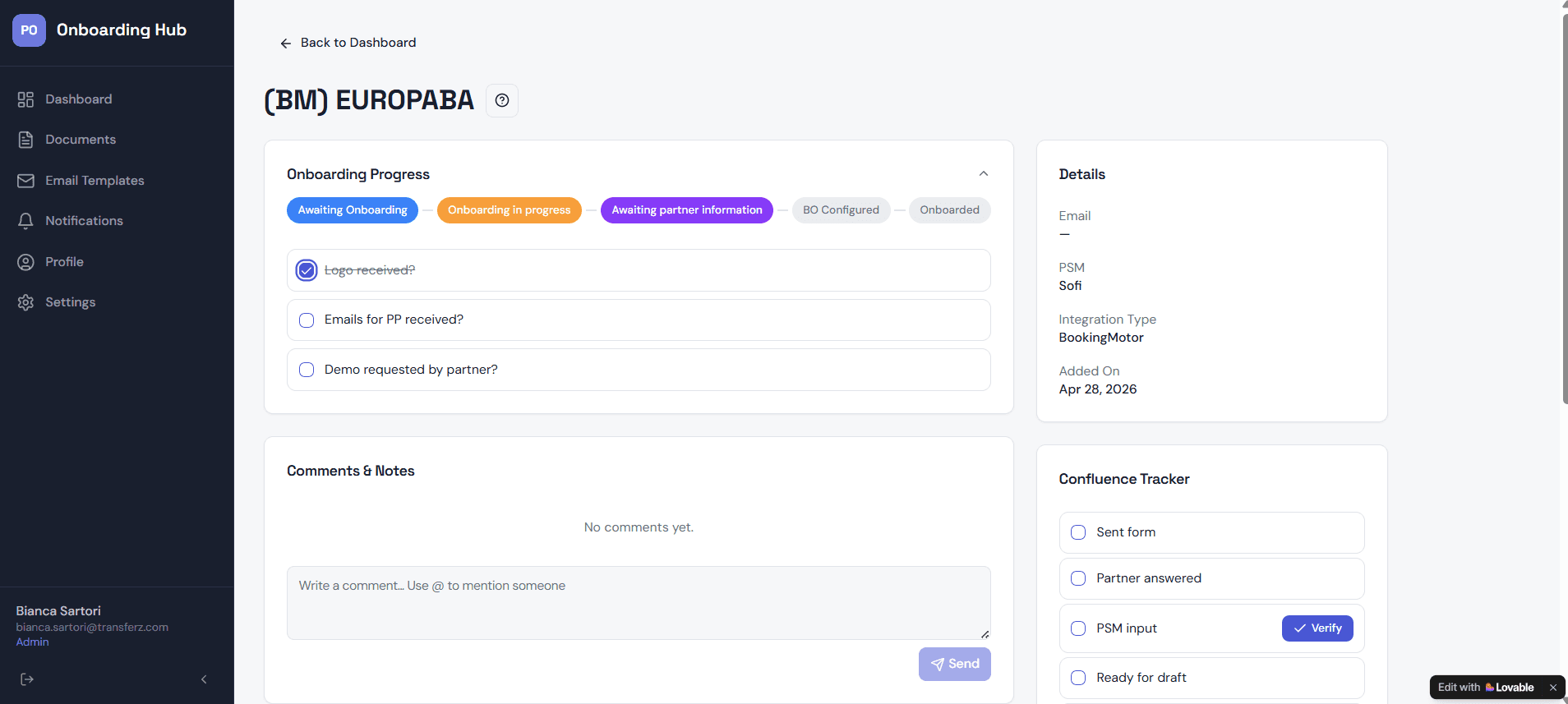
I built the Onboarding Hub in Lovable: a purpose-built internal tool that centralizes the entire partner onboarding pipeline in one place. Each partner has its own page with a stage-by-stage checklist for the onboarding manager, a Confluence tracker to monitor guide progress, a comments section for team notes, and a full activity log of every status change.
The goal wasn't to replace every tool we use — it was to create one place where anyone on the team could get the full picture without having to ask me.

Key Decisions
Three decisions shaped how the hub works. First, the pipeline is fully configurable — stages, colors, order, and the tasks inside each stage can all be managed from Settings without touching any code. The tool adapts to the process, not the other way around. Second, email templates are organized by stage and available in both English and Spanish, with a one-click copy — because switching between tabs to find the right template was its own source of friction. Third, the Pipedrive integration automatically adds new partners from closed deals directly into the dashboard, removing a manual step that was easy to forget.

Real Impact
The hub is actively used by the onboarding team at TransferZ. The question "what stage is X partner at?" now has a self-serve answer — anyone with access can check the dashboard without pulling me into the loop. Onboarding managers work through stage checklists directly in the tool, and email templates have reduced the time spent drafting repetitive communications from scratch.
What started as a personal organization system became shared infrastructure for the team — which is the best outcome a tool like this can have.

Constraints & What I'd Do Next
This was built as a working tool, not a design exercise — which means some decisions were made for speed rather than polish. There's no mobile view, the notification system is basic, and a few flows (like onboarding a new team member) still require admin intervention that could be more self-serve.
The most meaningful next step would be deeper Pipedrive integration — not just pulling partners in, but pushing stage updates back so both systems stay in sync without manual effort. I'd also want to run proper usability sessions with the team to surface the friction points I've normalized by being too close to the tool.
What I Learned
Building a real tool for real users — even a small team — is a completely different design problem than designing for a portfolio project. You can't control how people use it, what they ignore, or what they ask for that you didn't anticipate. The most valuable design skill this project pushed was knowing when to keep something simple instead of making it complete.
It also reinforced something I already believed: the best internal tools are the ones people use without being asked to.